Sailed from Holland to Muskegon. First part, wind was perfect. Waves could be measured in inches. We went fast for almost an hour.
And then we slowed as the wind dropped. The black flies found us, even three miles off shore.
Smooth sail, only saw three boats in thirty miles from Holland, and two came out of the channel with us. Such a smooth sail, Marcia went down to the V-berth and had a nap.
Timed it perfectly, arriving two miles behind the Lake Express – the cross-lake ferry from Milwaukee that makes the almost seventy mile crossing in two and a half hours. It’s a big catamaran, over 190’ feet (58.4 meters) long and nearly 60 feet wide (17.6 meters). The channel narrows to about 200 feet, so it’ll take up about half of the channel if you allow some safe distance. Add in the fisherfolk on the sides of the channel and it feels tight. Being overtaken in the channel by the Lake Express is not ideal and we avoid it like the plague. Ideally, you come in behind, sail across to the green can (#3) in deep water but outside of the channel so when the Lake Express makes its sécurité call before leaving the dock, you are well out of its way.
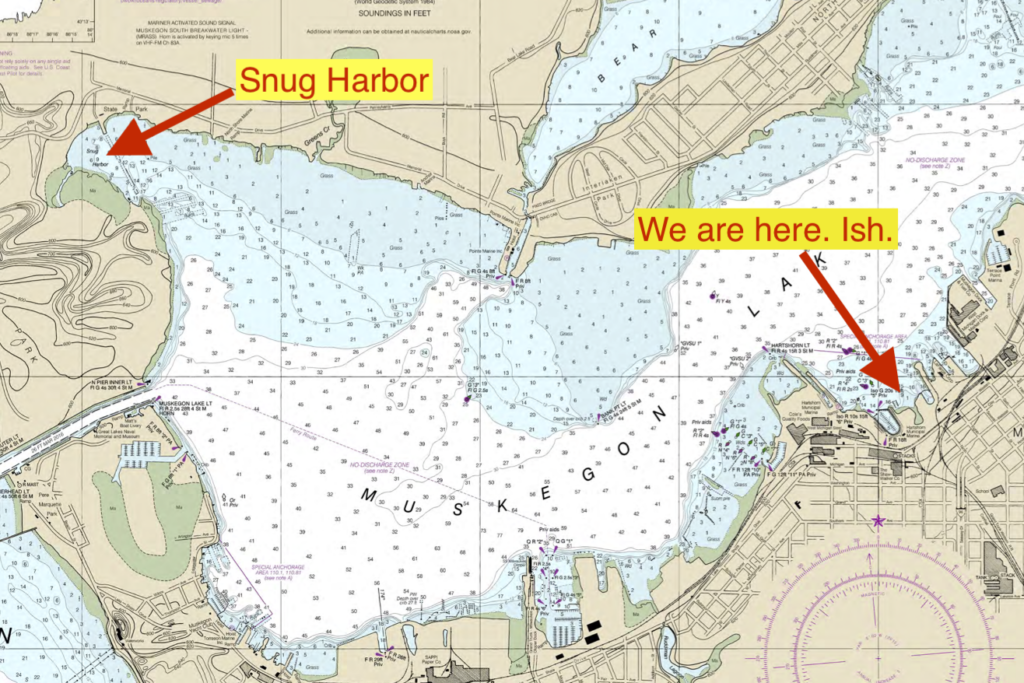
Ordinarily, we would have anchored near the state park in Snug Harbor. It’s well protected from north and west winds, but open to the southeast. Also, it’s right next to the state park boat launch so there’s a lot of traffic in the morning and evenings, and without a no-wake zone, the boats come in hot. Today, we’re sailing further in. Hartshorn Marina has a field of mooring balls ‘out front’. Our plan was to drop anchor closer to shore than the mooring field, and stay put for Tuesday. The forecast for Monday night had been for heavy showers and wind from every direction but North. The forecast for Tuesday is showers and fog.
Anchoring. Seems simple. Lower the anchor to the bottom of the lake, pay out the anchor chain (water depth plus freeboard to the anchor roller (that is the distance to the water from the roller) and multiply by 5 minimum but 7 is better.) 13 feet of water + 4 feet of freeboard = 85 feet of chain. Put the boat in reverse at about 2500 RPM to set the anchor. Attach the bridle to keep the chain away from the bow. Job done.
Wind from all directions, right? Our boat will point into the wind and be downwind from the anchor. The bow will draw a circle with about a 70’ radius. The helm position is over 30 feet from the bow. The discussion goes like this: “We were over there when we dropped anchor, and now we’re here, do you think we dragged?” “I think were okay, because the wind shifted” “Yeah, but we are nearly to the moored boats, at least even with them” “Right, but we moved a lot, and look how far offshore we are” “Is this how I set the anchor alarm?” “We’d never hear that from the V-berth” “We’ll use the boat computer in the saloon” “And we have to leave the stereo on because that’s where we can hear the alarm” “And the AIS, too” “We should leave the monitor on so we can just take a peek”
And we try to sleep. We ‘think’ we are set, the anchor alarm is set to 50 meters from the anchor, so we should be fine without a false alarm. Sleep. Wake up at 1am, looks right on the monitor. Looks different outside as it’s dark. Sleep again after being awake for a half hour or more. Two hours later, it starts to rain. Close the ports and hatches. Anchor watch, looks fine on the monitor but I need to see. Take the spotlight out to the cockpit, and now it’s really raining. Try to find any landmarks but all the light shows is grey.
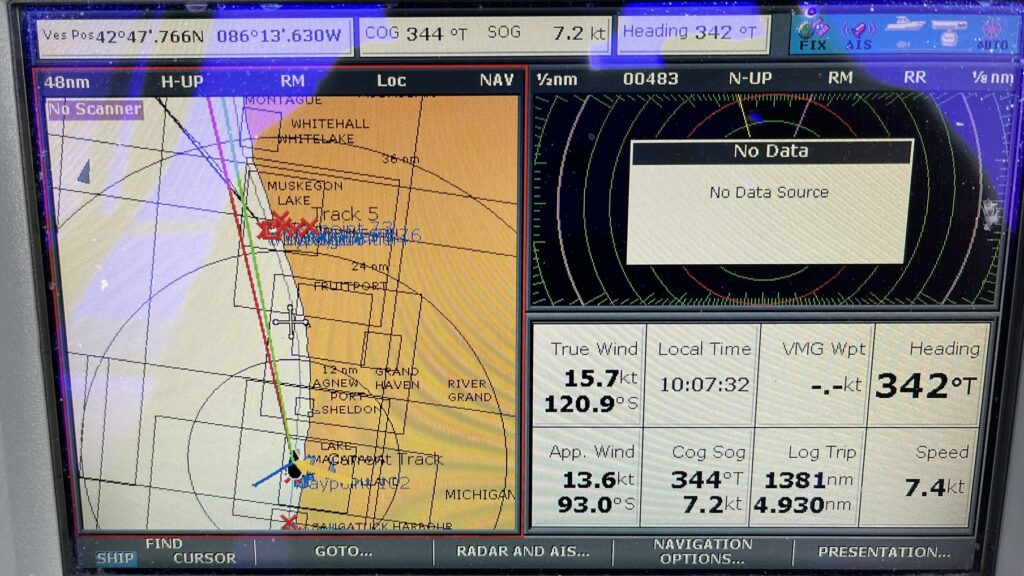
I guess we’re okay. Trust the chart program. Get back to sleep. Wake up. It’s grey, in all directions. For all I can tell we could be floating in the middle of the lake. Check the monitor, we went east, north and west – the track is a blob. The anchor held just fine.
Plug the coffee grinder into the inverter, and grind coffee. Fill the kettle, switch on the LPG solenoid, light the burner, start the kettle on the stove. It begins to whistle. Fill the French press with water. Pour a cup. “Oh, you’re up. Coffee’s ready”